Thursday, September 24, 2009

The Zoo

One of the many reasons I liked Biology classes in college was the fact that almost everything (starting with the word Biology--study of life) had a Greek name. Taxonomy was no problem if you knew a little Greek; Ovid's Metamorphoses and Bulfinch's Mythology were surprisingly useful.

Here a bare 20 minutes from a major city, we have more animal visitors than you'd think, and the zoa and phyta (animals and plants) are a constant reminder of our cultural heritage as well as of the natural state of the land before we humans intruded.

From the bird kingdom, phoebes (for Phoebus Apollo) show up at dawn, competing with the robins (Erithacus) for the earthworms (Oligochaeta or hairless animals). The ravens (Corvus or korax, croaking) rule the roost, all black-feathered since Apollo took umbrage at one of their messages. At night, however, Athene's owl calls from the cypress trees. The trees themselves are named for Kyparissos, who accidentally killed his pet deer and was fated to weep throughout eternity.

Down in the corner, two Daphne trees, named for the maid fleeing some ancient god's advances, recall the oracle of Delphi, who reputedly chewed laurel leaves in order to enter a transcendent state. Many of the plants have descriptive names in Greek: Chrysanthe(mum) is Golden Flower; Pyrocanthus is Fire Thorn.

Though we have a renegade deer or fawn which comes in the night and eats the rosebuds, we haven't seen much of the raccoons and skunks since we stopped putting out the garbage at night. The opossums have stopped coming around, too, and it has been years since I saw a garter snake.

The spiders (Arachnids, for the master weaver who challenged Hera, the wife of Zeus) are still on duty, of course, and gophers, slugs and snails (from the family of Mixozoa, slime animals) make gardening a challenge.

Two wild visitors this week stared at me through the window: A hummingbird hovered on the other side of the glass, a foot from where I was munching my sandwich. And a grey squirrel who had a long, fearless drink from the basin I keep out front, then hopped on a log and looked at me long and hard. I felt exactly as if I were on the other side of the bars at the zoo.

Saturday, September 19, 2009

Social Security Tango, Part Two


I have never really fit in very well, so it is no surprise that I've had trouble thinking of myself as a senior citizen. There's a stereotype of the Golden Ager (one of dozens of euphemisms for old people) which involves hobbies, cookies and gardening. My garden is neglected, I don't knit very well, and I only brag a little about my grandchildren.
So it was a bit of a stretch for me to go to the health screening at the senior center, though I liked the convenience of having several routine tests done at one place. I was dismayed to arrive fasting and with no coffee to find what looked like more than a hundred old people with a ten o'clock appointment at the center.

For a moment I thought I'd just go home and have the tests done the usual way at the hospital lab, but then one woman announced loudly that she had her own doctor and that she was leaving to have her lab work done privately. That was enough to ally me with the shuffling masses because I didn't want to be that woman. Secretly, I felt that I should be on the giving end rather than the receiving end of this service. I felt that I wasn't old enough or poor enough to take the place of someone who maybe couldn't afford to pay.

Unexpectedly, the line moved very efficiently, and within a half hour I had been weighed, measured, tested for cholesterol and glucose, and given a brief health advisory by a very nice nurse (Keep an eye on your blood pressure. Everything else is fine.)

Nobody asked me for proof of age, citizenship or anything else. Nobody asked for money.
I drove home feeling that some things are worth praising in this world.

Social Security Tango, Part One


When life has turned your cry of pleasure
into a wail
And you try to cut the mustard but you
sometimes fail;
When you can't believe the mirror 'cause you
still feel pretty young,
Here's a charming melody just waiting
to be sung.
It's the Social Security Tango.
Don't you anticipate it breathlessly?
The Social Security Tango
Shows how the government takes care
of you and me.
Just keep on working and salting
those credits away
And you'll be getting a big check one day
And do the Social Security Tango,
A rose between our teeth, a smile on our face.
We'll get senior citizen discounts
And eat at famous franchised fast food places,
And they will say how well preserved we are,
So agile and so spry
And though we'd rather just be sexy,
Ours is not to reason why,
And we will join the double A-R-P
and try to just get by
And do the Social Security Tango.

Thursday, September 3, 2009

Cane Guy and Push Guy

Beating, spanking and whipping in the classroom is frowned upon these days.

The era of "spare the rod and spoil the child" is so far past that tenured teachers who repeatedly strike students may be sent to a district Temporary Reassignment Center or Rubber Room while their cases are being heard. They must clock in and stay from 8:15 to 3:15. They get paid for the time they spend in the Rubber Room, an average of three years, with summers off.

Last week's New Yorker had a long article about one such room in New York. Someone I know had a close-up view of a different Rubber Room, and he told me about Cane Guy and Push Guy. Cane Guy, who came from an educational background where classroom discipline often involved beating, had been removed from school after repeatedly striking students with his cane. He spent his days at the reassignment center watching videos, waiting for his case to be decided.

Push Guy, whose offense was that he repeatedly pushed desks into students, spent his days on the telephone.

Push Guy complained that Cane Guy's videos made it hard to hear his phone conversations. Cane Guy turned up the volume. Push Guy pushed a desk into Cane Guy. Cane Guy hit Push Guy with his cane.

Violence is, of course, no laughing matter, but there was a certain Zen silliness about this story, especially since both Push Guy and Cane Guy had been removed from contact with children. The story shows that teachers' unions have some kind of clout, because teachers cannot be dismissed without due process. The teachers have to show up to get paid, even if they don't do any work, and therefore somebody can keep an eye on them.

And since they are not allowed contact with students, teachers like Push Guy and Cane Guy have only each other to pick on.

Wednesday, September 2, 2009

How To Write

“I wish I could write.” I hear this all the time. “I wish I could play the piano.” And I say (or think) “Well, why don’t you?”

Everybody has a story. Telling this story in words, paint, dance, music is a good thing in many ways. It breaks through the isolation so many people feel; it may teach; it may inspire. It doesn’t matter that other people have told the same story, because each person has his or her own point of view.

But how do you do it?

In newswriting, it’s a matter of telling something: Who, what, when, where, how.

But in fiction-writing, journaling, poetry (not to mention painting, sculpture and music) it is much more a matter of showing.

As an exercise, take an object, say a coin dug up while hoeing the garden, and write twenty thoughts about it.

1. It is a metal coin.

2. It seems to come from another country.

3. It is probably silver. It is not gold.

4. It seems to be English or Australian.

5. It is small.

6. There is a picture of Queen Elizabeth on the coin.

7. The date on the coin is 1973.

Now you see the difficulty in coming up with twenty thoughts. Already we are in the area of speculation: Did someone deliberately bury this coin? Who? Why? Was the coin lost? Who by? All sound proceeds from silence, and much good writing proceeds from mystery.

A trilogy by the great Canadian writer Robertson Davies begins with a snowball which has a rock inside.

Looking closely at something, almost anything, primes the pump for creative activity. It is just as simple as can be. It's even simpler if you have something you really want to say. Then it is more a matter of paring away the nonessential.

You notice that I have not mentioned spelling or grammar. This is craft, and I have been talking about art. Bad spelling, bad grammar and punctuation tell things about their user which that user would rather not have known. And if the writer has any hopes of success in a college essay, a job interview, or published work, there simply isn’t any way around writing the best you can in your native language. Many manuscripts have been rejected the first time an editor came across a possessive its with an apostrophe.

I have been writing, either as a job or for simple pleasure, for quite a long time. I love to tell a story, and I love to hear other people tell theirs. What's yours?

Saturday, August 29, 2009

Little Girl On a Rope Swing


The drooping leaves of the eucalyptus

were moss-green, not grey

as in the photograph, and the towering branches

would have been tinged with copper.

Black and white, she clings

to the sharp diagonal of the swing

at the farthest reach of its arc.

Whoever gave the swing a push

and took the picture is not shown,

not even in shadow. The child’s

shirt would have been blue, with stripes;

the jeans, well-worn, the color of

forget-me-nots. The girl on the swing

has her back to the camera.

She is looking up ahead

and you can see the edge of her face

lifting—she may be laughing—

but her shoulders are tensed

against the unknown.

Her feet, tightly together, look big

in their sneakers. She is

slight of hip but pudgy of waist.

Crowning this moment

was her riotous halo of

uncombed golden curls.

Monday, August 24, 2009

Playing for Church


Playing for church is a more exciting job than you might think.

I first played for church 60 years ago in Oak Ridge, Tennessee, for the Methodist church which met in an elementary school near our house. My mother made me do it. The church paid for my piano lessons.

On the Coastside, I have probably played for every church which has a piano or organ. I am well acquainted with their instruments, especially those of Community United Methodist Church, where for about 35 years I have played as a substitute, for services, weddings, funerals and choral performances. For years, I played for Coastside Lutheran on a tiny organ at the Odd Fellows’ Hall, facing the wall so that I couldn’t see what was going on.

I have a recurring church dream: I can’t find the church, I’m going to be late, I have forgotten my books (or clothing), and when finally I get there, nobody knows what’s going on. All these things except the clothing have actually happened.

There was a time I forgot my slippery flat organ shoes and my high heel got stuck in the pedal board. Or the time I got mixed up about daylight savings time and arrived to find the pastor’s wife in my place at the organ. It was pretty exciting when the old tube organ at the new Lutheran church began strobing and sounding like a mandolin. My favorite church music adventure was when the musician who was supposed to play for a wedding got stuck in traffic on Highway 92 and the dismayed wedding coordinator found me, in jeans, practicing in the choir room. I put on a choir robe and was trying to remember the chord changes for the processional while playing something else as the relatives and guests walked in. The bride was waiting at the chapel door when the regular pianist ran in, out of breath, and took over.

Or there was the sunrise service at the beach where I played the organ on a truck bed and the generator was louder than the organ. I think I wore gloves, it was so cold.

As an outsider (because I belong to a church in San Francisco which never asks me to play) I often daydream out during the announcements. However, many of the sermons and almost all the pianos and organs are memorable, most of them in better shape than that old tube organ—which has since been replaced with a modern instrument.

Even so, at the Lutheran church (for many years now in its own building on the Cabrillo Highway), you have to take vise grips to hold the music rack up on the otherwise very nice piano. At the Episcopal church, some of the organ’s pedal keys don’t work and you must avoid them. The Episcopal church once had a small piano with the names Princess Elizabeth and Margaret Rose embossed on it.

At the Catholic church, you have to make sure the transposer has not been turned on before you work with a singer. The Kawai at the LDS church has a killer stiff action and a pedal you need muscles to use. The Baptist church has a nice little grand piano which is kept in tune.

I have read and heard that there is a shortage of church musicians. The reasons may be that fewer people have put in the minimum twelve years of music instruction that it would take to play most written-out church music, or that many salaries are low and the time required too high, including evenings, holidays and weekends. Some of my church music friends simply don’t want to play the kind of music many churches prefer these days.

It is an odd kind of discipline, playing for church. You must expect the unexpected: Someone faints or begins to cry. At the last minute, they ask you to play something you’ve never heard, and they don’t have the sheet music. The power goes off and the electric organ dies and the church goes dark. Everyone is looking at you and you don’t know what they expect you to play. Someone doesn’t show up. Too many soloists show up, confusing the date. You play too many verses, or too few, and the people laugh. You and the congregation are widely at variance on the tempo of the hymns.

Although this won’t happen in most cases, you may step out the back door of the church into thin air. Community United Methodist Church in Half Moon Bay, founded in 1867, actually moved its chapel so that the front door faced Johnston Street instead of Miramontes Street, and they moved the church hall out to the south end of town. The back door for a time faced nothing at all (now it has steps.) Nobody told me about this the first time I played at the turned-around building, since all the church members, of course, knew about it.

The requirements for being a church musician are that you are dependable and prompt, that you always have your bookmarks in order, that you know most of the hymns and the popular vocal solos, that you always show up, that you demonstrate flexibility and an ability to lead the singing with your instrument, that you read music really well, that you know how to select voluntaries or solos which are appropriate to the occasion. It is a plus if you can look reasonably pleasant while dealing with all the surprises.

I have hundreds of books and a big binder full of music for church. The title of the binder collection is Winging It.


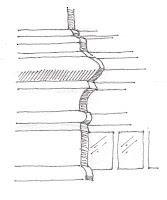
(Drawing is a wainscoting detail at Community United Methodist Church in Half Moon Bay.)