Playing for church is a more exciting job than you might think.
I first played for church 60 years ago in Oak Ridge, Tennessee, for the Methodist church which met in an elementary school near our house. My mother made me do it. The church paid for my piano lessons.
On the Coastside, I have probably played for every church which has a piano or organ. I am well acquainted with their instruments, especially those of Community United Methodist Church, where for about 35 years I have played as a substitute, for services, weddings, funerals and choral performances. For years, I played for Coastside Lutheran on a tiny organ at the Odd Fellows’ Hall, facing the wall so that I couldn’t see what was going on.
I have a recurring church dream: I can’t find the church, I’m going to be late, I have forgotten my books (or clothing), and when finally I get there, nobody knows what’s going on. All these things except the clothing have actually happened.
There was a time I forgot my slippery flat organ shoes and my high heel got stuck in the pedal board. Or the time I got mixed up about daylight savings time and arrived to find the pastor’s wife in my place at the organ. It was pretty exciting when the old tube organ at the new Lutheran church began strobing and sounding like a mandolin. My favorite church music adventure was when the musician who was supposed to play for a wedding got stuck in traffic on Highway 92 and the dismayed wedding coordinator found me, in jeans, practicing in the choir room. I put on a choir robe and was trying to remember the chord changes for the processional while playing something else as the relatives and guests walked in. The bride was waiting at the chapel door when the regular pianist ran in, out of breath, and took over.
Or there was the sunrise service at the beach where I played the organ on a truck bed and the generator was louder than the organ. I think I wore gloves, it was so cold.
As an outsider (because I belong to a church in San Francisco which never asks me to play) I often daydream out during the announcements. However, many of the sermons and almost all the pianos and organs are memorable, most of them in better shape than that old tube organ—which has since been replaced with a modern instrument.
Even so, at the Lutheran church (for many years now in its own building on the Cabrillo Highway), you have to take vise grips to hold the music rack up on the otherwise very nice piano. At the Episcopal church, some of the organ’s pedal keys don’t work and you must avoid them. The Episcopal church once had a small piano with the names Princess Elizabeth and Margaret Rose embossed on it.
At the Catholic church, you have to make sure the transposer has not been turned on before you work with a singer. The Kawai at the LDS church has a killer stiff action and a pedal you need muscles to use. The Baptist church has a nice little grand piano which is kept in tune.
I have read and heard that there is a shortage of church musicians. The reasons may be that fewer people have put in the minimum twelve years of music instruction that it would take to play most written-out church music, or that many salaries are low and the time required too high, including evenings, holidays and weekends. Some of my church music friends simply don’t want to play the kind of music many churches prefer these days.
It is an odd kind of discipline, playing for church. You must expect the unexpected: Someone faints or begins to cry. At the last minute, they ask you to play something you’ve never heard, and they don’t have the sheet music. The power goes off and the electric organ dies and the church goes dark. Everyone is looking at you and you don’t know what they expect you to play. Someone doesn’t show up. Too many soloists show up, confusing the date. You play too many verses, or too few, and the people laugh. You and the congregation are widely at variance on the tempo of the hymns.
Although this won’t happen in most cases, you may step out the back door of the church into thin air. Community United Methodist Church in Half Moon Bay, founded in 1867, actually moved its chapel so that the front door faced Johnston Street instead of Miramontes Street, and they moved the church hall out to the south end of town. The back door for a time faced nothing at all (now it has steps.) Nobody told me about this the first time I played at the turned-around building, since all the church members, of course, knew about it.
The requirements for being a church musician are that you are dependable and prompt, that you always have your bookmarks in order, that you know most of the hymns and the popular vocal solos, that you always show up, that you demonstrate flexibility and an ability to lead the singing with your instrument, that you read music really well, that you know how to select voluntaries or solos which are appropriate to the occasion. It is a plus if you can look reasonably pleasant while dealing with all the surprises.
I have hundreds of books and a big binder full of music for church. The title of the binder collection is Winging It.
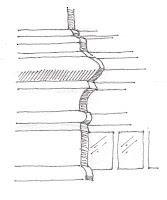
(Drawing is a wainscoting detail at Community United Methodist Church in Half Moon Bay.)


